WW-II, as experienced by John Hubbell
This account was written by my father in 2000 for his grandchildren.
What Did You Do in the War, Granddaddy?
World War II (1941-1945)
John Howard Hubbell, 8668 (5858)
b. April 9, 1925, Ann Arbor, Michigan
Military Service, U.S. Army, June 17, 1943 to November 13, 1945
Army Serial Number 36860612
1. Draft and Induction.
By "The War," I don't mean the Revolutionary War, or the Civil War, or the "Great War" (1918) or the other assorted U.S. military skirmishes. By "The War," I mean World War II (1941-1945). I may be old, but not that old!
In my boyhood home town of Manistee, Michigan in public school I can recall in the late 1930s, in current events newsletters, reading about Hitler and his push through Poland and other places he wasn't supposed to be, along with the accounts of Mahatma Gandhi and his fasts for social reforms in India, in that time period. These events and places seemed very far away, and things closer to home were more important.
Then, I have a clear memory of that Sunday afternoon December 7, 1941, when Bob Turner, a classmate at Manistee High School and fellow model-airplane enthusiast, and I were at his house working on a trigonometry assignment for math teacher Mr. Reo Gonser (a tough taskmaster, but I got along well with him). Bob had his radio going for some background music, when a news flash broke in with announcement of the Japanese attack on a big chunk of the U.S. Fleet berthed in Pearl Harbor, Hawaii, with extensive loss of lives. On the Monday immediately following, addressing Congress, President Franklin Roosevelt pronounced that Sunday as "a date that will live in infamy." We were at war, and those far away places suddenly became uncomfortably close with their impact on my generation.
All of my male classmates and I had to register for the draft, and since I turned 18 in April, 1943, I had to obtain a deferment in order to graduate from High School in June. My "GREETING" from the President of the United States arrived, dated June 4, 1943, stating:
"Having submitted yourself to a local board composed of your neighbors for the purpose of determining your availability for training and service in the land or naval forces of the United States, you are hereby notified that you have now been selected for training and service therein. You will, therefore, report to the local board named above at the American Legion Rooms, City Hall Bldg., Manistee, Michigan at 10:30 a.m. sharp on the 17th day of June, 1943. This local board will furnish transportation to an induction station. You will there be examined, and, if accepted for training and service, you will then be inducted into the land or naval forces."
All of my male classmates with 18th birthdays June 1943 or earlier received the same offer they couldn't refuse, and we showed up en masse at the American Legion Rooms at our appointed time.
The remaining classmates, with later 18th birthdays, reported for duty similarly over the succeeding months. One of these classmates, with a November 1943 birthday, was Dick Johnson, son of our neighborhood grocer. In our High School physical fitness class, which was a sort of pre-military conditioning program, one of the requirements was to jump off an eight-foot wall onto a mat on the gym floor, I suppose simulating a parachute-jump landing. In one of these jump sessions, Dick injured his leg to the extent that he was not accepted for military service in World War II. However, he was later reclassified and conscripted into the Army during the Korean "police action." Dick's service at several stateside Army posts included a tour at Camp Hood, Texas where I had my basic training as described in the next section of this report.
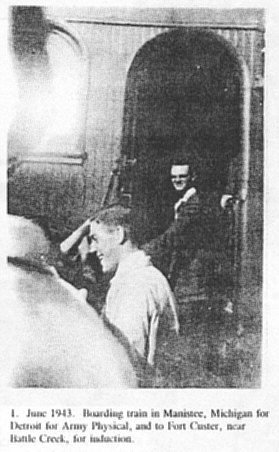 After gathering first at the American Legion Rooms, we then headed for the train station to board a train to Detroit to the Induction Center. I vaguely recall that it was through the night, and the cars were not Pullman (sleepers). In Detroit, if we had had any sense of modesty and privacy, it was gone forever as the assembly-line physical exams were accomplished. I also recall being questioned by someone, perhaps a psychologist or psychiatrist, about my sex life, from which I learned there were many available interesting activities of which I had never been informed.
Along with almost everybody else, I was declared fit for military service, but not for the more glamorous occupations, such as navy flier, due to my eyes which needed glasses with a strong correction. It was back on the train, still without any sleep since leaving Manistee, heading for Camp Custer (shades of Little Bighorn) at Battle Creek (more and more ominous!), Michigan to be inducted into the United States Army. The first item on the agenda was to take the AGCT (Army General Classification Test), a kind of intelligence test for placement purposes. My score was 130, not enough to put me in the Mensa but not bad for 48 hours without sleep, and enough to destine me for the ASTP (Army Specialized Training Program), a college program aimed at a long-range supply of Army Engineers. Among my classmates who went to Custer for Army induction, three others, Richard Janesheske (our Class Valedictorian), Albin Hughes and Joseph Bachinski also scored high enough to qualify for the ASTP program.
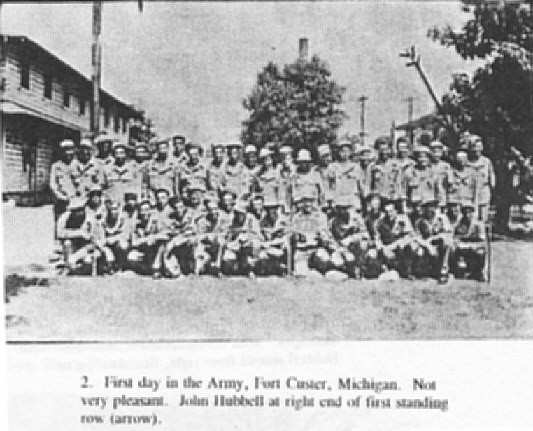 At Custer, we each bundled up our civilian clothes and mailed them back home to our families in Manistee, and were fitted out with the basic Army uniform and fatigue clothing, everything olive drab including underwear. In being measured for my Army shoes, I was given a bucket of sand to hold in each hand, spreading my feet out simulating the weight of a full field pack on my back. My first day in the Army was not very pleasant, but I had survived.
2. Basic Training, Camp Hood, Texas.
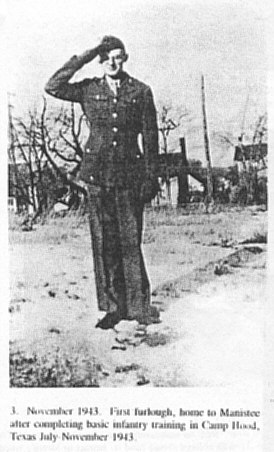
Prior to entering the ASTP college program, we were required to undergo the thirteen weeks of basic Army recruit infantry training. After a week or so at Custer, Dick, Albin, Joe and I were "bingoed" (summoned for transfer) and were back on the train, headed for Camp Hood, near Waco, Texas. This time we had the luxury of Pullman cars. We were put two of us in bunks that were built for one (or for one very friendly couple), but we could at least stretch out and snooze at night.
Arriving in Texas, it was now summer, and the heat was on! Although it was infantry training, we were officially part of a Tank Destroyer unit, so on our dress uniforms our identifying shoulder patch was an orange/gold background surrounding the head of a black panther crushing a tank with his big teeth, very snazzy. We had a vigorous physical training program, with lots of push-ups and forced marches. The biggest challenge was trying to dig foxholes (holes big enough to crawl into to avoid enemy fire and also shrapnel from nearby shell bursts) in the local pale pink terrain called "coliche," a kind of ground-up weathered coral. When wet, this coliche would be mud up over your ankles, but in the dry Texas summer heat it was like solid rock.
I recall temperatures several days in that Texas summer of 1943 that went to 115o F in the shade, except that there wasn't any shade. In my letters home which my Mother saved, I see I told her 132o in the shade and 142o out of the shade, but perhaps those were "Texas degrees." At the end of a day in the field, the cuffs of my fatigues (greenish denim work clothing) were caked with salt, from my perspiration running down my arms and evaporating through my cuffs. We had a tough Company drillmaster Master Sergeant Svoboda who ruled over us with an iron hand, from reveille in the morning when we exited bleary-eyed from our barracks to stand in formation to call "here" when he barked our names, to taps at night when the flag was lowered and we could collapse into our upper or lower bunks as the case may be. I recall a drainage ditch he "requested" some of us to dig in the infernal coliche, we called "Svoboda Gulch."
Barracks life was regimented in the full sense of the word, with S.O.P. (standard operating procedure) to be followed to the letter, or there would be dire consequences. Beds had to be made with "hospital corners" of the sheets and blankets, the top blanket being required to be stretched tight enough so that the Sergeant could bounce a quarter off it, with a lively bounce. There was only one way to hang up a shirt or jacket. The left sleeve, with the snazzy black-panther shoulder Tank-Destroyer patch, absolutely had to face out into the room, so that all shirts and jackets faced left, on the hanger rod. To this day, I am incapable of hanging up a shirt or coat facing to the right. My lovely wife Jean (a "southpaw," but I think this has no bearing on the matter) invariably hangs up her garments facing right, which blows my mind, but I have long ago made my peace with non-S.O.P. penchant. However, whenever I have the opportunity to hang her coat for her, you know which way it will be facing!
We were forever "policing up the area" which mostly meant picking up cigarette butts, I resented because I am a non-smoker. To this day, the tiniest piece of paper or other man-made debris in the yard around our house immediately gets picked up, another habit "wired in" from the Army experience. Also, in the field training exercises under the blazing Texas summer sun, a single canteen of water was supposed to take care of all needs for the day, including holding enough back to wash a wound, in the combat days to come. To this day, at the dinner table, my beverage remains mostly untouched until the very end of the meal "just in case." Now, when I observe my grandchildren swigging down their entire beverages at the beginning of the meal, I find this rather unsettling. However, of course they are right. There is an unlimited supply of additional beverage in the nearby faucet or bottle, and there even exist ice cubes, disdained by any self-respecting toughened G.I.. "G.I." stands for Government Issue, originally referring to Army clothing and matériel, eventually referring also to the soldiers themselves.
For our training arms, we were issued vintage British Enfield .30 caliber manual bolt action rifles, since all the new M-1 Garand gas-operated semi-automatic rifles were in too much demand at the overseas fighting fronts. The Enfields had quite a "kick" to them, resulting in a lot of sore shoulders when we were shooting live ammunition. The Garands were much gentler, since some of the recoil force (from the bullet and gas leaving the barrel) was put to work operating the bolt, leaving less force to bruise the shoulder. The day before we were to go to the rifle range to shoot "for record" my glasses met with an accident, getting stepped on in the pocket of my fatigue jacket on the bench in the shower room. Hence, at the range, I couldn't see the bulls-eye on my target, nor even read the numbers above the targets, so I had to count down from the end to determine which one was mine. As a result, I received a very low rifle score to go in my records, and I am convinced this had a bearing on the determination and assignment of my military occupation later on.
I think other Army veterans will agree that the infiltration course is the scariest event in the thirteen weeks of basic training. In this course, a field is covered with barbed wire staked one or two feet off the ground. At one end of the field there are several .30-caliber water-cooled machine guns on platforms, with wooden bars under the front ends of the barrels so that their deadly horizontal fans of bullets stay at least three feet above the ground. We were then required, dragging our Enfield rifles and other equipment, to crawl across the field toward the machine-gun platforms, much of the time wriggling on our backs to keep the barbed wire from snagging our clothing, while real bullets were zipping over us supposedly at three feet (we questioned, they seemed closer!). There were a lot of stories of recruits going berserk, standing up, and getting killed, I could easily believe.
3. ASTP, Hope College, Holland, Michigan.
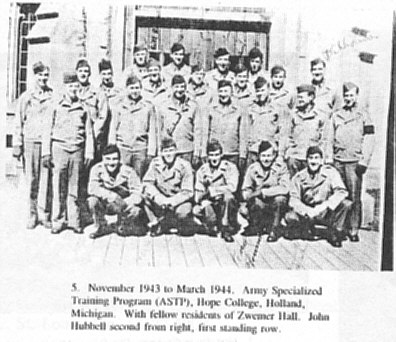 "Bingo" time finally came in October, 1943, and the four of us from Manistee were back on the train, heading for our pre-engineering college training under the Army Specialized Training Program (ASTP), having survived our 13 weeks of Army Basic Training and acquired a bit of a Texas drawl and swagger. Through some benign decision-making process, our schooling would be at Hope College, Holland, Michigan, less than 100 miles south of Manistee, also bordering on Lake Michigan.
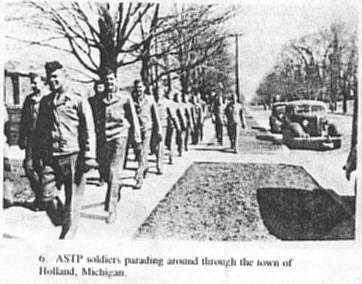 In this sleepy town of wooden shoes, windmills and tulips, we enrolled in a heavy schedule of freshman-level courses including mathematics (trigonometry and algebra), physics, chemistry, English, history, geography and military science. The military science consisted mostly of close-order drill, and some parading around Holland tying up traffic, but the residents were very good-natured about all this. Our shoulder patches now were changed from the macho tank-crushing black panther logo to the more genteel ASTP patch which was an Aladdin-type lamp with superimposed an Excalibur-type sword pointing upward. This was supposed to signify "the lamp of knowledge, crossed by the sword of valor" but among the G.I.'s it was said to signify "the knights of the flaming [chamber]-pot."
The most exciting course was chemistry. Some of the G.I.'s were very enterprising about mixing chemicals which should never be mixed. In one laboratory class (not mine) an explosion blew out the nearby window, and it was fortunate that the budding "Alfred Nobel" was wearing glasses, otherwise the shattered rack of test tubes would have taken his eyes as well as making a mess of his face. My class was also enterprising, but limited its extra-curricular experiments to glass-blowing tubing into little ampules which we then filled with hydrogen sulfide in solution. We had planned to put one of these ampules under the leg of our instructor's chair, so that when he sat down the ampule would break and produce the characteristic odor of rotten eggs, but I don't recall that we ever carried out this nefarious scheme.
 Being so close to home, we did manage to spend several week-ends at Manistee. Also, for one week-end, I went by train to visit my Aunt Margaret (and Uncle Ralph) Johnson in Milwaukee, Wisconsin. This meant going down around the south end of Lake Michigan, and in Chicago changing not only trains, but also changing stations which were some distance apart. All worked fine until the trip back to Holland, when I missed my intended train out of Chicago and had to take a much later one. This meant I arrived back at my dormitory in Holland in the wee hours of Monday morning, well past the expiration time of my week-end pass. In effect, my carriage had turned back into a pumpkin, and I was AWOL (absent without leave). Finding my bunk, it looked like I was already there, since my well-intentioned roommates had stuffed pillows under my blanket to try to fool the orderly who did the nightly bed-check. Unfortunately, he was not fooled, and the next day I was called on the carpet by the Commanding Officer, Captain Morgan. He was kind enough to understand the entire situation, and that I had nothing to do with the intended ruse, so there was no penalty.
After completing the first term of the ASTP and the final exams, there was some attrition in the ranks. Dick Janesheske, Albin Hughes and I from Manistee survived into the second term, but Joe Bachinski didn't quite have the grades, so he and a number of others were shipped out to join regular Army units, for overseas duty. Joe then became a part of and a casualty of Operation Overlord, General Eisenhower's June 6, 1944 D-Day assault on Hitler-held continental Europe, at the brutal Normandy beaches. After the war was over, when Joe's body was sent back to Manistee, Albin and I served as pall-bearers for Joe. At Boy Scout and Church camps, the bugle call "Taps" means "Day is done, gone the sun, ...." but from this episode it will always also mean "Goodby, Joe."
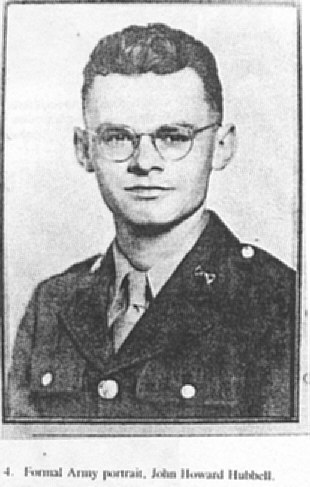 In the early months of 1944 it was clear to the military planners that the war was heating up, with an increased tempo inconsistent with long-range programs such as the ASTP. Hence in March 1944, at the midpoint of our second term at Hope College, this program was terminated, and we were all "bingoed" off to regular Army units for further training and overseas service. We had earned 1½ terms of college credits, which later could apply to a civilian degree program.
4. Combat Unit Training, Camp McCoy, Wisconsin.
The remaining three of us from Manistee, Dick, Albin and I, were finally split up, and my assignment, in March 1944, was to the 76th Infantry Division which had just finished winter training in Watersmeet, Michigan, and was now in Camp McCoy, near La Crosse, Wisconsin. Instead of heading toward the Army Engineer officer rank, had we stayed with the ASTP track, we "college boys" would remain at the lowest enlisted-man rank (Private) for our combat training and duty, since all the ranks above Private (Corporal, Sergeant, etc.) in the Division were already assigned, before we were absorbed into it.
Through no choice of my own, at Camp McCoy I found myself as the gunner in one of the two machine-gun squads in the Weapons Platoon, which also had three mortar squads, of Company L of the 304th Infantry Regiment, 3rd Battalion, of the 76th Infantry Division, United States Army. A Battalion consists of four Companies of about 150 men each, our 3rd Battalion being Companies I, K, L and M. There is no J Company in the U. S. Army, due to "i" and "j" being indistinguishable in the old German alphabet, and the early role of the Prussian General Corps in establishing military procedures and structure. [In Washington, D.C. you will also find "J Street" missing from the lettered streets, for related reasons, I think.] Companies I, K and L each consisted of three Rifle Platoons and one Weapons Platoon. M was the Weapons Company, with heavier fire power such as .50 caliber machine guns mounted on jeeps, and 80 mm mortars instead of our 60's.
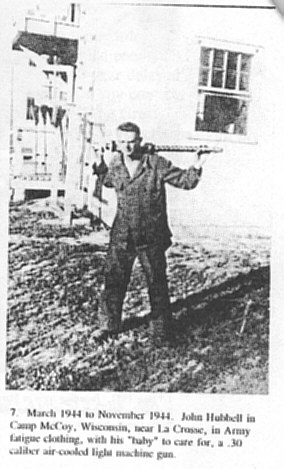 I am not sure why I was selected as a machine gunner, since I had generally considered myself a mild-mannered peaceful type of person. My only clue was the poor score in basic training with the rifle, due to my glasses being broken the day we shot for record, back in Texas with the Tank Destroyers. With a machine gun, the classifiers perhaps reasoned, it would be like squirting water out of a hose, watching where my fiery visible tracer bullets (every fifth round) were going, and adjusting my aim accordingly.
My shoulder patch changed again, to the 76th Division logo which was more abstract than those of the T.D.'s and the ASTP. It was a shield shape, red in the lower part and blue in the upper part, with something that looked like a white telephone in the upper blue field. At least, it was patriotic: red, white and blue.
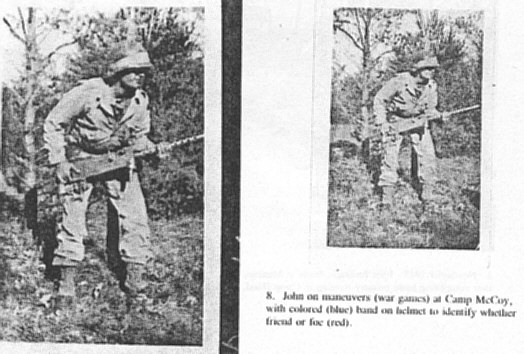 Our machine guns were .30 caliber air cooled, with jackets around the barrels, each jacket perforated with exactly 76 holes (more patriotism: "Spirit of '76") to allow cooling of the barrel which could glow cherry red with sustained firing. Each belt of ammunition contained 500 rounds, and after the first cocking of the bolt to put a round in the chamber, the burst of fire would last as long as the trigger was held. When the chamber, at the base of the barrel, got too hot, the machine gun could keep firing without benefit of trigger and firing pin, and the only way to stop the runaway was to grab and twist the belt, preventing the next round from entering the chamber.
In training, the gun had a spindle underneath which fitted into a low tripod which the assistant gunner carried. Overseas, the spindle and tripod disappeared, and in its place there was a bipod supporting the front of the barrel, and a metal shoulder stock at the rear, similar in configuration to the B.A.R. (Browning automatic rifle) but with more fire power. I carried the gun, which weighed about 30 pounds according to my memory, plus on my pistol belt I wore a .45 caliber Colt Model 1911 automatic pistol, with extra clips of ammo, a couple of fragmentation grenades, a canteen of water, and a trench knife. Fortunately, overseas, the latter item saw more service in opening K-ration tins, than for "close encounters of the worst kind." The rest of the squad carried lightweight .30 caliber carbines plus two boxes of machine-gun ammo (a belt of 500 rounds in each box) one in each hand, except the squad leader Leonard Keith who carried a .30 caliber Garand rifle, and was supposed to be more free to spot targets and tell me where to point my stream of tracers.
In both Camp Hood, Texas and in Camp McCoy, Wisconsin I managed most Sundays to attend the Protestant services in one of the chapels scattered around the posts. Catholic services were held in the same chapels, at different times. One Sunday, in Camp McCoy, Holy Communion was offered as part of the service. In my Methodist Church back in Manistee, Communion was always with grape juice representing the wine. Also, both my Mother and my Grandmother (Jenny Lipe) were staunch members of the W.C.T.U. (Women's Christian Temperance Union) and held offices at the State level, so I had since infancy been raised in the presence of pictures of livers and other organs of people who had been ravaged by the evils of John Barleycorn and his assorted alcoholic offerings. The youth group of the W.C.T.U., the L.T.L. (Loyal Temperance Legion) had its pledge, which I signed and I can still recite from memory: "I promise, God helping me, not to buy, drink, sell or give, alcoholic liquors while I live. From all tobacco I'll abstain, and never take God's name in vain."
But, on that fateful Sunday in the Army chapel Communion service, real wine was used, so I had my first taste of alcohol! Actually, I recall it had a rather pleasant taste and sensation, but I resisted continuing going "down the primrose path," remembering an alcoholic cousin, and not knowing if I might get similarly hooked. Overseas I had an occasional sip, particularly when it appeared we would have to storm the Japanese beaches when we finished with the Germans. However, once I was out of the Army, I reverted back to my teetotaler wired-in habit, often to the horror and dismay of my wine aficionado friends, particularly in Europe, but also in the U.S. and elsewhere, at their elegant, sophisticated and well-oiled dinners and other special occasions.
At Camp McCoy our Company L Weapons Platoon, under the uncompromising command of Platoon Sergeant Paul DiFabion, became a cohesive group, with ties closer than with family, for the time we were together. On the long marches, in addition to the conventional "Sound off! ....," and "Over hill, over dale, we will hit the dusty trail, ...." and "I've got sixpence, jolly, jolly sixpence, ...." and other conventional ditties, we made up one of our own. To the tune (roughly) of "MacManara's Band" it went:
Oh, we're the boys from the Weapons Platoon,
We're not so very neat,
We never wash our underwear,
We never wash our feet.
We carry wooden mortars,
And wooden machine guns, too,
Oh, we're the boys from the Weapons Platoon
And who in the h___ are you?
Now, as we go marching,
And the band begins to P-L-A-Y,
You can hear the Captain shouting,
The Weapons Platoon of Company L is on the loose!
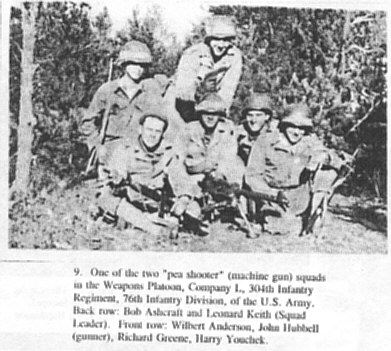 In the Weapons Platoon there was some friendly rivalry between the two machine gun squads (the "pea shooters") and the three mortar squads (the "pipe fitters"). We pea shooters kidded the pipe fitters about hiding behind hills to do their fighting. Their equipment was the 60 mm mortar, which was a hollow unrifled pipe on a hinged flange base, with an adjustable support leg in front to set both the elevation angle and the azimuthal direction of the pipe for the desired trajectory. At the bottom of the pipe was a fixed firing pin. The mortar shells looked like little bombs (which they were) with tail fins. Attached to the tail-fin end were several "increments" of explosive propellant. For the maximum range, all increments were left attached, and for shorter ranges one or more increments were removed and discarded. The shells were dropped down the tube tail-fins first, hit the firing pin which detonated the propellant THOOMP! and back up the tube came the shell, into a graceful high arc, over the hill and down on perhaps a machine gun nest of the opposite party, delivering a burst of deadly shrapnel on encountering its first solid object.
We privates all had our periodic turns at K.P. (kitchen police) in the L Company mess hall, which fed about 150 of us. On these occasions we would be rousted out of our bunks at 4:00 a.m. or some such gosh-awful hour to assist the mess sergeant in the breakfast preparation, then on to lunch and dinner. We would not see those bunks again until 11:00 p.m. or so, after the last dinner dish and coffee mug were washed, the last enormous cooking pot was scrubbed, and the wooden mess hall floor and table tops were scrubbed with brushes and plenty of lye soap. I think the modern Army has mechanical potato peelers, but we peeled our potatoes by hand with knives, perhaps 100 pounds or more at a sitting. I can recall one time when two of us were sharing this chore, and the mess sergeant thought our peelings were too thick. So, we spent another hour or so, peeling the peelings.
Army food was really pretty good, but we had our songs about that, too, to sing on the long marches:
The coffee in the Army, they say is mighty fine,
It looks like antiseptic and it tastes like iodine.
I don't want no more of Army life,
Oh Mom I gotta go, oh Mom I want to go,
Oh Mom I gotta go home.
The biscuits in the Army, they say are mighty fine,
One fell off the table, and killed a pal of mine.
(Refrain again)
The 76th Division had acquired a War Cry: "Onaway" I think borrowed from one of the Native American tribes in the Wisconsin area. The word had a nice "movement" sense to it, we would see a lot of in the days to follow.
5. Travel Adventures, from Camp McCoy to Luxembourg.
By late Fall of 1944, following the June 6, 1944 D-Day invasion, the Allied Forces had cleared the Germans from most of the coastal countries, but Nazi resistance stiffened as the battle line fell back to the original German border. The services of the 76th Division were still required in Europe, so we packed all our weapons for the overseas voyage, each with a heavy coating of cosmoline, a kind of sticky petroleum jelly, to keep the salty ocean spray from rusting them en route. Our port of embarkation was Boston, and I recall our troop train had the luxury of Pullman cars, so we could stretch out for the trip from Camp McCoy to Camp Myles Standish in Massachusetts. After Thanksgiving dinner in that part of the country where this ritual began, the 304th Infantry Division boarded the S. S. Brazil and joined a convoy of other troop and cargo ships ("Liberty ships") for the hazardous crossing of the North Atlantic, still infested with German u-boats (submarines) and their deadly torpedoes.
The Brazil was a commandeered cruise ship, and would have been dwarfed by the modern "floating hotel" behemoths. My five-high tier of bunks was on the Promenade Deck, with canvas outside walls to keep us sheltered from the weather. The bunks consisted of canvas stretched over steel pipe frames, and there wasn't much room between them. Fortunately, the G.I. above me wasn't a heavy-weight, so I had my allotted inch(es) of clearance. The cooks on the Brazil were British, and the cuisine was not the greatest. I particularly remember their idea of dessert which was a patty of cream of wheat with a dab of jelly in the middle. Also, with the roll of the ship, any dish or mug not tightly held would slide away down the table one direction or the other. I don't remember getting seasick myself, but there was a lot of that going around. I do remember that a lot of money changed hands in dice games.
I think our convoy lost one or two Liberty ships and their crews to the German submarines, but after twelve days at sea the Brazil berthed at Southampton, and we were billeted for a month in nearby Bournemouth. In the ancient houses where we were billeted, vacated by Brits who had moved inland fearing a German invasion, there was no central heating. Each room had a little fireplace and a supply of damp coke which burned very reluctantly. Each fireplace had its own flue, and the forests of chimneys on the rooftops were quite a sight. It was a cold December. During that month I had a three-day pass to London, and was impressed by the many blocks around St. Paul's Cathedral of total devastation, yet the Cathedral itself suffered only minor damage. The Germans had pretty much stopped bombing England with piloted aircraft, but they were still using pilotless ram-jet "buzz-bombs." London received a few hits during my two nights there, one near the Tower Bridge.
Christmas Eve 1944 found me and a couple of my buddies in a Bournemouth pub, and as a rare treat, the bartender supplied me with a glass of milk. We were not aware that at that very time, the "Battle of the Bulge" was in progress in the areas of Belgium and Luxembourg we would be seeing shortly.
A day or two after Christmas, we were back in Southampton, this time to board LST's (landing ships, tanks) to cross the Channel to France. Landing at Le Havre, we marched in the snow about ten miles inland, to then bivouac for the night. My squad leader Sergeant Leonard Keith and I were supposed to tent together, snapping our two shelter-halves together to make a complete pup tent. Somehow, neither of us had brought our tent poles and pegs, so we each just spread shelter-half and blanket out on the snow and curled up and slept. In the middle of the night, we were roused up for a hot meal, scrambled (powdered) eggs laced with cubes of Spam. Delicious! Returning to our sleeping area, we found our shelter halves and blankets frozen tight to the ground. We had to abandon them, as we were moving out shortly after the meal, but from then on we would be mostly billeted in sheep-barns and other structures. Also, someplace along the line, I cadged a black lightweight wool lap-robe, which became my blanket for the duration.
One member of our Platoon, Dan Groden, was a veteran of the Spanish Civil War, on the loyalist (losing) side fighting against Franco, with an impressive bullet-wound scar in his shoulder. He was also good with languages, so the Captain commandeered him to use this skill, also to walk in front of him in case of land mines. Dan didn't step on a land mine, but in the snow he did step through the rotten cover over a cess-pool. Since he was still attached to our Platoon for eating and sleeping, he showed up at our sheep-barn, and I can tell you he smelled a lot worse than the sheep!
From this area, near Le Havre, the next leg was by train in the famous "40 and 8" box cars, so named because on the sides was printed "40 Hommes ou 8 Chevaux (en longueur)" (40 men, or 8 horses, lengthwise). The train took us up past Bastogne to Champlon, in Belgium, just days after the Germans had been pushed back out of this area after their "Battle of the Bulge" surprise counterattack foray. At Champlon we transferred to trucks, the all-purpose 2½-ton 6x6 (power on the front axle, plus power on the two rear axles, so all six wheels had power). When used as personnel carriers, a bench seat dropped down on either side in the back. For some reason, I was sitting on my inverted helmet, when it popped out from behind me and out of the truck. Hence, I arrived at the fighting front, near Echternach at the Luxembourg-German border, without my steel helmet. Somehow, I had also parted company with my entrenching (foxhole-digging) shovel.
6. Combat Experiences, from Luxembourg to the Rhine River.
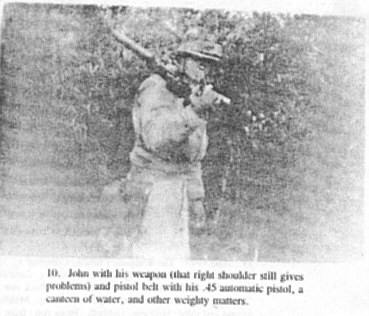 We were placed into action in a momentarily static situation, looking across the Sauer River from Luxembourg into Germany, at the vaunted Siegfried Line, a string of interconnected concrete pillboxes guarding the Fatherland with machine guns, and larger artillery pieces behind this formidable first line of defense. One of our cooks had graciously given me his helmet, knowing I might have more need of it. There was no immediate need for my missing shovel. There were plenty of artillery shell-burst craters to serve as foxholes, providing a second shell didn't land in the same spot. We found it prudent to move occasionally. A few yards from one of my positions, I saw my first two dead Germans, from an earlier skirmish, lying face up in the snow. Both in their Wehrmacht overcoats, one was a dark-haired older man, perhaps in his forties. The other was a boy in his early teens, with blonde hair. Hitler was scraping the bottom of the barrel.
Our foxholes were muddy in the bottom, and a major hazard was trenchfoot, which could lead to amputation. To reduce this possibility, I kept one pair of socks inside my undershirt, next to my chest, where they dried out to some extent, and changed them for the ones on my feet frequently. There were a few trees around still standing, and sometimes among them I heard a bird, making come alive the lines from John McCrae's poem In Flanders Fields:
".... and in the sky
the larks, still bravely singing, fly
scarce heard amid the guns below."
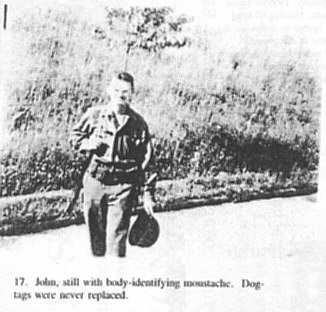
Somehow, in this time period, I also became detached from my metal identification tags ("dog tags") worn on a plastic cord necklace, embossed with name, Army serial number and blood type. Thus, "to help identify the body" I raised a moustache. My tags were never replaced, through the balance of my Army career. The 76th Infantry Division was now part of General Patton's 3rd Army. General Patton insisted that all men under his command wear neckties in combat, so that we would look like "good soldiers" in case of either death or capture.
We were fed one hot meal, in the middle of the night, when we took turns leaving our foxholes to go to where the cooks had brought out the "buffet" from where they had prepared it behind the front lines. We were instructed to bring only half of our two-part mess kits, the part with the long handle so we could dip them in the pot of hot water to clean them with the provided brush after eating. If we used both halves, the jangle invited a burst of German machine gun fire toward our feeding station. Back home, in my earlier life, I always kept the various foods on my plate well separated, ignoring the fact that they were destined to be all mixed together in my stomach. Here, I have a strong memory of first receiving a ladle of beef stew, then a dollop of butterscotch pudding, right on top of the stew!
Our other two meals were K rations, which came in Cracker-Jack type boxes, we carried back to our foxholes. They contained one can of potted meat, some reputed to have the brand "Red Heart" stamped on them, some hard crackers, a bar of hard chocolate, and a supply of olive-drab toilet paper. There was also a small pack of cigarettes, usually the "Fleetwood" brand, which now leaves me unimpressed by Cadillac's "Fleetwood" line of fancy automobiles. As a non-smoker, I usually could find someone who would trade me his chocolate for my cigarettes. There were other types of field rations: C rations which were single-serving cans of such delicacies as pork and beans, and "10-in-ones" which were boxes containing canned and other foods which would serve 10 men for one meal, but these were used by echelons behind the lines, not at the front where we were.
We were not entirely static during this time of building up toward the big push into and through the Siegfried Line. There was a lot of night probing going on, including the 3rd Battalion's "Tiger Patrol" which donned white snowsuit coveralls and tried to see how far they could penetrate the German defenses before they made some contact and had to withdraw. There were some casualties from this exercise.
The Germans were still sending ram-jet buzz bombs (V-1's) toward London, and at night we could hear them passing over us en route. Occasionally one of them would suddenly go quiet, and a little while later we would hear the explosion where it had dropped out of the sky like a stone, as they had very little wing surface and depended on sheer power for flight with their 1-ton warhead of high explosive. The Germans were also sending their larger V-2 rockets over us to England, also to Belgium and France, up until March 1945, but they had high trajectories and we never saw or heard them.
Finally, in late January, 1945, it was time to move across the Sauer River on the nice pontoon bridge the Army Engineers had made for us at Echternach. By the time Company L made its crossing a fair beachhead had been established on the German side. Included in the equipment already across was a forebodingly long, long line of field ambulances we walked by on our way to tangle with the Germans. Beyond the ambulances, we headed up a hill, in the vicinity of Ferschweiler, toward where we could hear the characteristic rapid fire of German machine guns (much faster rate of fire than our U.S. models). Suddenly we began receiving fire from our right flank, and some of our guys started returning fire. For some reason, I withheld mine. Other people were suspicious, and finally contact was made with the source of the flank fire. It was B Company, from the First Battalion of our own 304th Regiment, who had confused us with the Germans we both were hearing just over the hill. Unfortunately, this "friendly fire" resulted in a number of unnecessary casualties, including one of our "pipe-fitter" mortarmen killed only about ten feet from me. His face, with a trickle of blood from a bullet hole through his forehead, will be forever etched in my memory. Our Company L Commander Captain Dale, standing up to direct the action, received a bullet in the groin, but fortunately it was not fatal. He was the first of the several Company Commanders we lost as the days would progress.
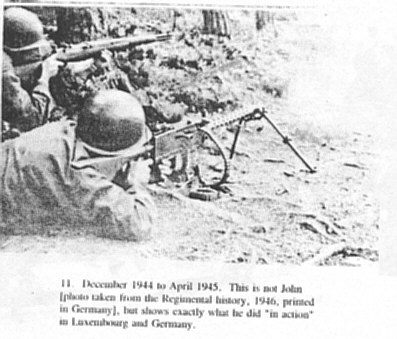 We continued to work our way up and over the hill, and I found myself digging some "quickie" foxholes with my helmet, since I had never replaced my missing entrenching shovel. Finally, my "pea shooter" squad had worked our way down the hill through the woods, to the edge of the trees where we could look across a low-lying meadow to the hill on the other side where the Germans were dug in, and giving us a hard time. The plan was, I was to spray the Germans with enough machine-gun fire to keep their heads down, so that they wouldn't be able to fire at our riflemen crossing the meadow (underneath my fire) to overrun the German positions. With Sergeant Keith lying beside me to direct my fire, I "did my thing" at some length, with the barrel eventually glowing red from the sustained fire, and my glasses steaming up under my helmet. I never actually saw anyone, friend or foe, fall from my fire, for which I am thankful. At some cost, we were successful in this first "real war" action. I did take an entrenching shovel from one of our fallen riflemen, who no longer had use for this or anything else.
It was now early March, 1945, and our next major-action objective was Orenhofen, normally a sleepy little town but now bristling with German fire power, both small-arms and artillery pieces. To get there, we would first have to cross the River Kyll, which had high steep banks on either side. Again, in the first part of the night, our intrepid Engineers had found a place to put a pontoon foot bridge across, and through the rest of the night we (I, K and L Companies of the 304th) scrambled down the bank, picked our way across the wobbly bridge and up the other side. Orenhofen was about 500 yards ahead, along a dirt road, along which a vast amount of lead was exchanged between us and the dug-in German snipers and machine-gun nests. At some cost, we took and secured the town, and prepared for the inevitable counterattack. We were now well out in front of the main Allied advance, and stuck out like a sore thumb.
The counterattack was mostly artillery and mortar fire, but also a tank tried coming toward us until one of our crack shots managed to get its driver's vision slit, putting it out of action and the crew scrambling out of the opened hatch. K Company lost its Commander Captain Herb Bottjer, when the outhouse he was momentarily occupying took a direct mortar shell hit. Lt. Abernathy then became K Company Commander to replace the dead Bottjer. Our attrition among our officers seemed to be worse than among the enlisted men.
Most impressive, at Orenhofen, were the Germans' "screaming meemies," a kind of rocket fired in salvos from a bank of perhaps 50 launching tubes on the back of a truck. I have a vivid memory of Tom Leary (my assistant gunner) and me peeking over a cemetery wall at such a launcher which was a bit out of machine-gun range, seeing the flash of the multiple launching, and seeing, hearing and feeling the screams of the "meemies" as they passed over us en route to the center of town.
Eventually the main line of the Allied advance caught up with us, and it was "Onaway!" again. I recall in one of the dug-in German fortifications we over-ran, they had left some of their food behind, consisting of hard rye crackers (knäckebröd), and Limburger cheese in toothpaste-type squeeze tubes. It was a welcome change from our current steady diet of K rations and D rations (little bars of dense hard chocolate, for "on the move") despite the repulsive odor of the cheese. Later, out of the Army, I would enjoy a snack of the smelly cheese for some years to come.
I guess we had the edge over the Germans in our supplies of ammunition, and we engaged in a lot of "marching fire," moving toward the enemy firing steadily and profusely, to the extent that the Germans kept down in their trenches, and were even wary of looking and shooting out through the slits in their concrete bunkers, until we over-ran them, taking them prisoners to be shepherded back to our rear. One of these massive concrete bunker complexes was built into the side of a hill, and as I was walking up the hill over it, momentarily without a belt of ammo in my machine gun, up out of one of the holes (like a rabbit warren) popped a German right in front of me, with red cross on a square of white across his chest, indicating medic, saying in English "I surrender!" No need to use our carefully learned phrases: "Waffen niederlagen!" (Lay down your arms!) or "Ergeben Sie sich!" (Give yourself up!).
We regrouped back down the hill, in what seemed like a protected flat area in front of the main concrete front face of the bunker. Unfortunately, the nearby German artillery unit, using 88 mm antiaircraft guns, apparently had our spot well-marked on their maps. Their shells began to rain in on us, blowing craters four or five feet across and sending shrapnel in all directions. We of course "hit the dirt" to minimize what the shrapnel might do to us. One of the shells impacted about ten or fifteen feet from me. Between me and the burst was lying Sergeant Kownaski (from the pipe-fitters) so his back absorbed all the shrapnel that would otherwise have had my name on it. Fortunately, he did recover from these wounds. Eventually the shelling stopped, and it was "Onaway!" to the next objective.
A little later on, in the course of another counterattack, Tom Leary and I were very-snugly sharing a foxhole when a piece of shrapnel zinged in on us, making a superficial scratch on the back of Tom's hand. When things let up a bit, he got a band-aid from the medic to keep it from getting infected. As a result, he was awarded the Purple Heart medal for "wounded in action." I have to wonder, what his parents back in Boston thought, when they were so informed.
We were now in the Moselle River valley, snaking our way through the forests of grape stakes in the hillside vineyards bordering the river, following our current Weapons Platoon Leader 1st Lt. Robert Parlaman. Lt. Parlaman made me think of a displaced college professor, but he was also great as a leader of our merrie band. He had traded a captured German Luger 9 mm pistol (we foot soldiers had more opportunities for such acquisitions) for a .45 caliber Thompson submachine gun from a tank driver in one of our cooperating Armored units, and with it took care of several "obstacles" from his "point" position. In one of our single-file traverses through the grape stakes along a contour of the steep hillside, I remember hearing German machine gun fire coming from the opposite hill on our left, and seeing immediately to my right the dirt kicking up from those bullets. Later, I found a new tear or two in my clothing, but "no scratch, no Purple Heart."
My Mother saved letters I managed to write home from time to time, and this one is typical:
"[From Lieser, on the Moselle]
March 10, 1945, Germany
Dear Mom,
Things aren't quite so bad now. Each time we capture a town we [mostly, Dick Hartmann] run around and "police up" all the fresh eggs, hams and preserves we can eat, thus ignoring our monotonous emergency "K" rations. There are still miserably cold night vigils in foxholes, and the Heinies still throw everything, including the kitchen sink. at us. I'm getting so that I mind the rain, mud and long hard marches more than the "screaming meemies," 88's, and mortar shells. One gets used to the sight of sudden and violent death, but the drudgery is something else again.
Your letter with the stamps and also two packages with fudge, canned peaches, and malted milk tablets arrived since I wrote you last. They came just before we "jumped off" on an attack, so some of the fellows left their packages on the jeep so that they would have them when we settled down in another town. During the night a screaming meemie made a direct hit on the vehicle, blowing it sky-high.
Pardon me, we're taking off again to clean out another town, so I'll have to close.
Love,
John"
Besides the "sudden and violent death" I saw a lot of silent death, bodies of soldiers stacked up like cordwood, waiting to be loaded on trucks to be moved back to the rear areas where they could be positively identified and otherwise processed. A lot of families back in the USA would get their visits from the customary military representative, and the blue star hanging in the window would be taken down and a gold star would be hung in its place.
I think the German civilians we encountered were tired of Hitler's War, and they generally seemed glad to see us. Sometimes they lined up along the sides of the streets as we marched through, with hot coffee and other libations to pour into our canteen cups to give us a lift.
From the German military, however, there was still a lot of objection to our trespassing deeper and deeper into their Fatherland. Our 3rd Battalion surgeon's diary tells of one episode, crossing a mine field shortly before we reached the Rhine: "A small path had been taken by some of K Company's men. One hit a mine and was killed instantly while another was critically injured. Lt. Abernathy tried to prevent (our) new aid-man, McGee, (Pvt William D. McGee, 35573768) from going in for the men but the kid couldn't be stopped. He got in, gave MS (morphine) to Jasper Holm of K, shifted his own position and was blown sky high by a trip wire mine . . . we got the information and got Holm and McGee into the aid station . . . McGee was still full of fight but in bad shape. He kept chattering. Gave him considerable plasma and shipped him back----hopefully . . . He died the next day." McGee was awarded posthumously the Congressional Medal of Honor, becoming the only awardee of this highest military honor in the entire 76th Infantry Division.
We finally arrived at the Rhine River, at the town of Bingen, and I wasn't feeling too good. In one of the houses we commandeered, I found a fever thermometer, marked in Celsius instead of Fahrenheit degrees. From high school physics I remembered the conversion formula, and found I was running a fever of 107o F. Under these circumstances I wasn't much of a "fighting machine" so I checked in with the Battalion Aid station. My temperature was confirmed, and I was loaded into an Army ambulance, along with an elderly lady who had been hit by shrapnel from the continuing German bombardment from across the Rhine, to head for a field hospital in a big tent at a safer distance behind the front lines.
When we arrived at the field hospital, the lady in the adjacent stretcher was dead, but I fared better, and was diagnosed as having infectious mononucleosis. This ailment is sometime known as the "kissing disease" but I can vouch that no such opportunity had been given me; it was apparently just the chronic fatigue of combat over the past months. I was transported by train (passenger, this time, not the "40 and 8's") to a regular hospital in Commercy, France. While my buddies were racing across central Germany, riding on tanks and other armored vehicles, after crossing the Rhine on an Engineers' pontoon bridge north of Bingen, at St. Goar, I spent a month in the hospital recovering from my "mono" before being pronounced fit to go back into action.
7. The War in Europe Ends. Occupation, then Home Bound.
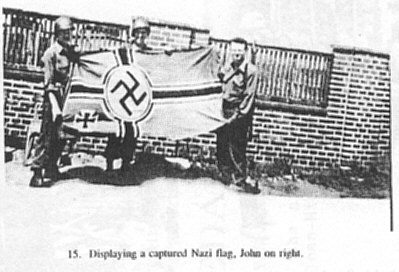
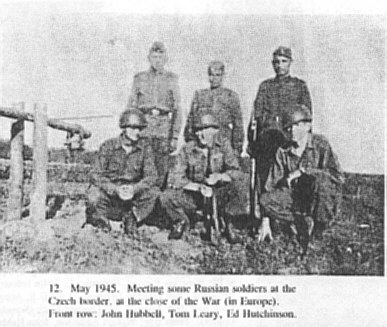 May 9, 1945 was V-E Day (Victory in Europe). By the time I rejoined my buddies they were all the way to the Czech border, and would have been farther, except a political decision had been made, for the U.S. forces to stop and wait for the Russians to come and meet us from the opposite direction. From Altenburg, just inside the German border, some of us did meet some of the Russian soldiers at a border post, affording a photo opportunity. We were billeted in a munitions factory, and there was a plentiful supply of "penta" explosive, blasting caps and fuse material for some of us to experiment blowing some safe doors to see what might be inside. Some of the poorly-printed deutschmark currency, in denominations up to the millions, gave a clue to the runaway inflation which had plagued Germany.
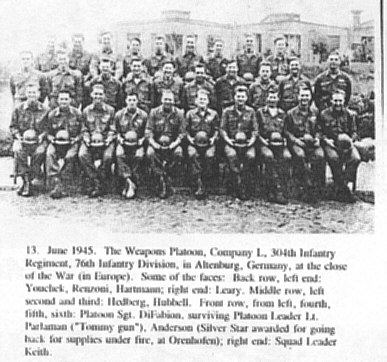 Moving to the town of Meuselwitz for a more extended stay, as part of the Army of Occupation, we were billeted in homes taken over from their German owners. I was amazed at the young children who came around, begging for candy and gum, who spoke perfect English. Some sadder begging, were the elderly ladies who came to our mess hall with their large tin cans, asking us not to scrape our food-leavings from our plates into the garbage cans, but rather into their proffered cans. I somehow struck up an acquaintance with a German girl Ingeborg Mädler, and arranged to have an evening with her and her parents in their apartment home. Earlier in the day, a young boy had come around with a bottle of wine to trade for some candy. This seemed like the proper thing to bring to the Mädlers, so a deal was made. That evening, Mr. Mädler uncorked the bottle with the appropriate flourish and poured some out to taste. What a surprise! The "wine" was really water. We had some good laughs about the "Wasser-Wein" (water-wine), and how I had been taken in by the little rapscallion.
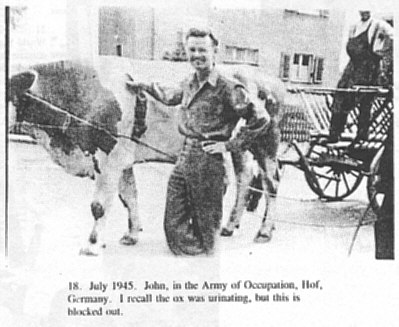
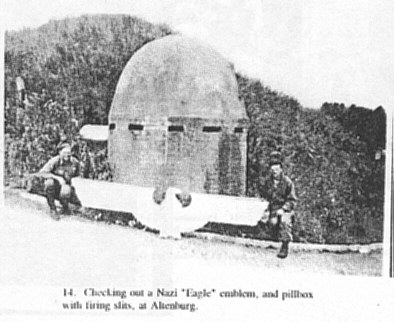 Both Altenburg and Meuselwitz were deep inside what was to become the Russian Sector of divided Germany, I think the result of the Yalta Meeting between Stalin, Churchill and Franklin Roosevelt. Hence we were moved to Hof, just outside what would become the "Iron Curtain" to spend a little time before we would be transported to the Pacific theatre where the war was still going on, for another "D-Day" invasion, this time into the Japanese mainland. In Hof, in the house next to where I was billeted, lived the Müller family, who did my laundry in exchange for soap enough to do their own laundry also. Besides a toddler son, they had a daughter Ruth who again added some sparkle to life. After returning to the U.S. I corresponded with both Inge and Ruth, who would have enjoyed being "war brides" I suppose, but the relationships tapered off after a year or two.
 .
.  .
.  .
. 
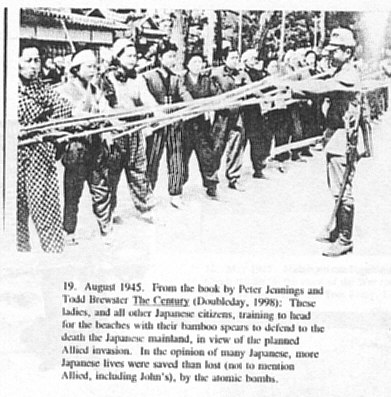 Our ships were waiting for us in Marseille, France, to take us to Japan and back into harm's way. Many years later, a well-known Japanese nuclear chemist Prof. Paul Kuroda told a scientific conference I was attending about how the Japanese military wanted to fight to the death if invaded, and he [Paul] would have been down on the beach with his bamboo spear to repel the invaders [and I would have been on the wrong end of his spear]. I never had a confirmation of this story until I found in the recent book by Peter Jennings and Todd Brewster The Century (Doubleday 1998) on page 276 a photo of Japanese women being instructed by an army officer on precisely this use (to the death) of their spears against the anticipated invaders.
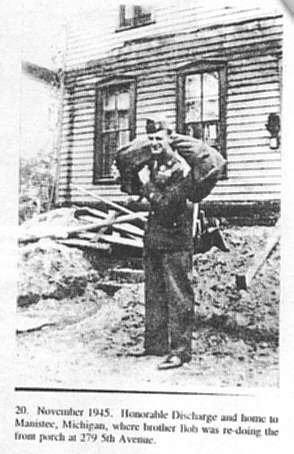 The atomic bombs on Hiroshima (August 5, 1945) and Nagasaki brought the war with Japan finally to a decisive and abrupt end, and I was spared the choice of either being skewered by a bamboo spear or having to perforate these dear Japanese ladies with my machine gun. Terrible as the bombs were, Paul Kuroda is convinced that the Japanese casualties would have been even higher, not to mention the terrible cost in American lives, had the planned land invasion taken place. For my personal situation, the result was that our outfit didn't go to Marseille, but instead headed back to England for a month including another three-day pass to London. On August 26, 1945 we boarded the Queen Elizabeth I from Southampton for a quick five-day voyage to New York. From New York we went by train to Fort Leonard Wood, Missouri where we marked time as part of the 8th Infantry Division, from which I received my Honorable Discharge November 13, 1945. The winged emblem to sew on our lapels to signify discharge, to obtain greatly-reduced train and bus fares, was nicknamed the "Ruptured Duck."
A major benefit to World War II veterans, for those of us who survived, was the "G.I. Bill," providing financial support for college or trade school education, covering a period commensurate with one's length of service. I took full advantage of this opportunity, and I enrolled in the Spring of 1946 at the University of Michigan in Ann Arbor. With my infantry basic training counting as the required physical education courses, and transfer of ASTP Hope College academic credits, I managed to obtain a Bachelor of Science in Engineering Physics in 1949 and a Master's Degree in Physics by 1950, leading to my employment as a radiation physicist at the National Bureau of Standards (now the National Institute of Standards and Technology) in Washington DC from 1950 to 1988 (and beyond, as a retiree/contractor and as an editor-in-chief of a scientific journal).
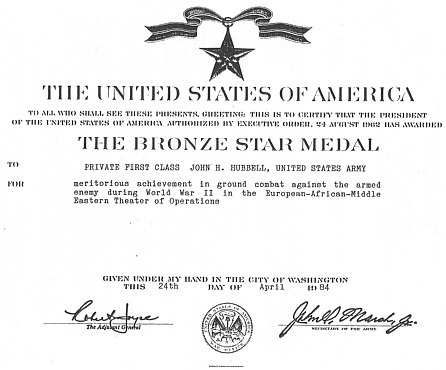
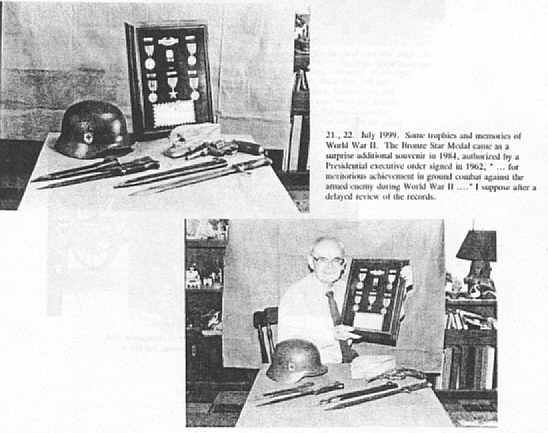 When discharged in November 1945, I was given the various colorful service ribbons listed on my discharge certificate, including the European Theatre ribbon with three battle stars (Ardennes, Rhineland, and Central Germany). In 1982 there was an article in Parade Magazine "Did You Get Your Medals?" giving the address to write, providing your name, Army serial number, and period of service, to receive free of charge actual medals corresponding to the authorized ribbons. It sounded like something nice for the grandchildren to look at, and only cost me the postage stamp, so I wrote to the address. Over a year later, in 1984, a box came, full of nice jangly medals. To my great surprise they included a Bronze Star Medal, as a result of a 1962 Presidential executive order, crediting me "For meritorious achievement in ground combat against the armed enemy during World War II ... ." Since then, I have shamelessly exploited this 40-year-delayed medal, along with my photo with the Russian soldiers at the Czech border, in my contacts with my Russian scientific friends who were taught in Russian schools that "The Great Patriotic War" against Germany was won by them with very little help from the Americans.
At my suggestion, and mentioning my name in the article, Parade Magazine, for a Veterans' Day item in its Sunday November 14, 1993 issue, again provided the addresses, here repeated in case anyone reading this account is similarly qualified and would like to receive some nice jangly medals:
Army veterans should write to: Army Reserve Personnel Center (DARP-VSE-A), 9700 Page Ave., St. Louis, Mo. 63132-5200.
Air Force and Army Air Corps veterans should write to: National Personnel Records Center (Military Personnel Records), 9700 Page Ave., St. Louis, Mo. 63132-5100.
Navy, Marine and Coast Guard veterans should write to: Navy Liaison Office, National Personnel Records Center (Military Personnel Records), 9700 Page Ave. St Louis, Mo. 63132-5100.
Return to Album Index